The answer is that the robot is not the point. The process of making the robot work is the point. Identifying why something is not working. Forming a hypothesis about what might fix it. Testing the hypothesis. Finding out it did not work as expected. Adjusting. Testing again. Succeeding. This sequence of encountering a problem, thinking about it systematically, acting on the thinking and learning from what happens is one of the most important cognitive habits a person can have and it is one that most traditional school formats do very little to develop deliberately.
STEAM education, which adds Arts to the STEM framework of Science, Technology, Engineering and Mathematics, takes this further by insisting that creative and design thinking are not separate from technical thinking but deeply integrated with it. The most interesting engineering problems are also design problems. The most useful data analysis requires the ability to communicate what the data means to people who are not data analysts. The boundary between technical and creative capability is more porous than educational systems that separate them suggest.
What STEAM Actually Looks Like in a Primary Classroom
Project-based learning is the pedagogical approach that makes STEAM genuinely work at primary level. Without project-based learning STEAM is just an expanded set of subjects. With project-based learning it becomes a way of organising how children encounter knowledge and develop capability through sustained engagement with real problems that require multiple types of thinking to solve.
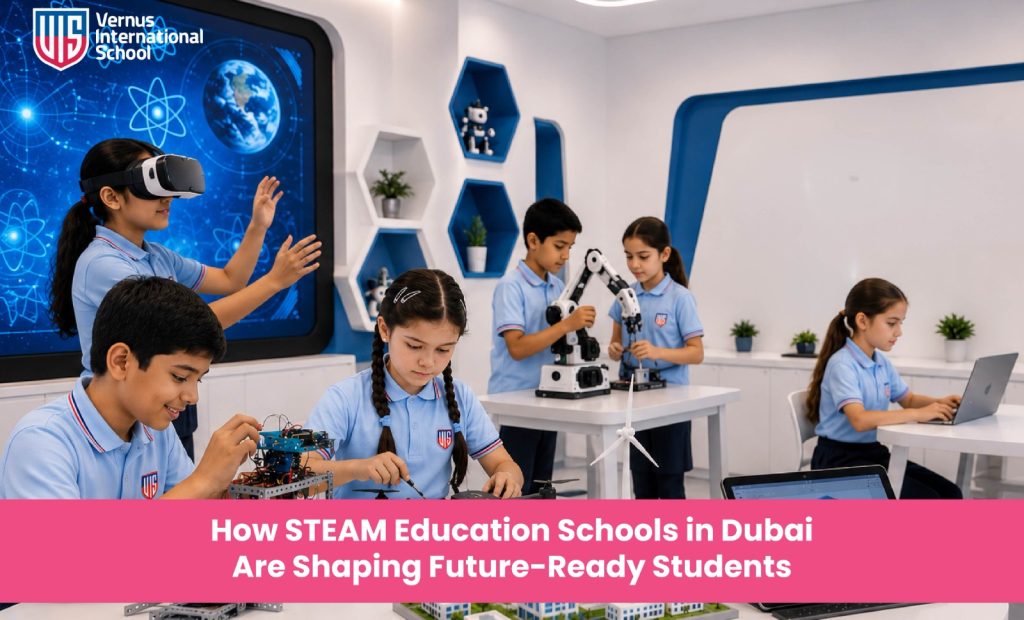
STEM education schools in Dubai that are doing this well have classrooms that look different from traditional primary classrooms. There are things being made and tested rather than only things being written. There are conversations happening between students who are trying to figure something out together rather than children listening to a teacher explain a complete answer. The assessment is of process and capability rather than only of outcome and product.
Virtual reality as a learning tool in a primary STEAM programme changes the kind of problems children can engage with. A child can walk through a coral reef to understand marine biology in a way that a textbook image cannot replicate. They can experience historical environments. They can visualise mathematical concepts in three dimensions. The VR experience is not a replacement for hands-on learning. It is an addition that extends what hands-on learning can address into domains that would otherwise be entirely abstract.
Why This Matters Now Specifically
The children currently in primary school in Dubai will enter the workforce in the late 2030s and early 2040s. Predicting what jobs will exist at that point with any precision is not something any educator or futurist can honestly claim to do. What is possible to say with confidence is that the ability to solve unfamiliar problems, to learn new things continuously, to work effectively with others across different types of expertise and to think creatively within technical constraints will be as valuable in that future as it is now and probably more so.
These are the capabilities that genuine STEAM education develops. Not the knowledge of specific STEAM content, although that matters, but the habits of thinking and the confidence to engage with difficulty and complexity that working in STEAM frameworks from an early age produces.
Vernus International School in Dubai Silicon Oasis has an Innovation Lab, STEM programme and Virtual Reality learning as confirmed features of its curriculum. The school serves Pre-K through Grade 5 and the STEAM and project-based learning approach runs through the whole primary programme rather than being added at a specific year level. For families looking at steam schools in Dubai or stem education schools in Dubai that are working with genuine primary-age pedagogy rather than simply building impressive-looking facilities, visdubai.com is worth visiting to understand how the curriculum is actually structured and delivered.
FAQs
1. What is the difference between STEM and STEAM education?
STEM covers Science, Technology, Engineering and Mathematics. STEAM adds Arts, recognising that creative and design thinking are integral to technical problem-solving rather than separate from it.
2. What STEAM facilities does Vernus International School have?
The school has an Innovation Lab, a STEM programme and Virtual Reality learning tools as part of its curriculum infrastructure in Dubai Silicon Oasis.
3. Is project-based learning more effective than traditional teaching for STEAM subjects?
Research consistently supports project-based learning as producing deeper understanding and better retention especially in STEAM subjects where applying knowledge to real problems develops capability that content delivery alone cannot produce.
4. At what age should children start STEAM education?
Early primary and even kindergarten are appropriate starting points. The cognitive habits that STEAM education develops, curiosity, systematic thinking, iterative problem-solving, are most effectively developed when they begin early as part of how children first encounter formal learning.
5. How does Virtual Reality support STEAM learning at primary level?
VR allows children to experience environments and phenomena that would be entirely abstract through textbook-based learning. For science, geography and mathematics in particular the ability to visualise and experience concepts three-dimensionally deepens understanding in ways that two-dimensional representation cannot.