The way education gets talked about in Dubai has been shifting steadily for a few years now, moving away from the old picture of a teacher standing at the front of a room delivering content to rows of children who sit there quietly receiving it, toward something that looks a fair bit messier on the surface and, as it turns out, does a considerably better job of building the kind of capabilities children are actually going to need once they’re adults navigating a world that looks very different from the one most of their parents grew up in.
Different schools give this shift different names, which adds to the confusion for parents trying to compare options. Project based learning. STEAM. Innovation labs. Virtual reality classrooms. These aren’t simply different words for the same underlying idea, and they definitely aren’t interchangeable add-ons that can be sprinkled onto an otherwise conventional curriculum to make it sound more contemporary on a school’s website. Each one represents a genuinely specific choice about how children spend their classroom time and what they actually walk away having built by the end of a lesson, a term, or a full school year.
What Project Based Learning Is Actually Doing
Project based learning schools in Dubai, and frankly everywhere else this approach has taken hold, are making a fairly specific claim about how learning works. The claim is that children learn more deeply, and hold onto what they’ve learned for longer, when they’re using knowledge to actually make or solve something rather than simply receiving information with the intention of repeating it back accurately on a test a few weeks later.
There’s a meaningful body of educational research sitting behind this claim, built up over decades of classroom study across multiple countries. There’s also a fair bit of implementation risk attached to it, because project based learning done poorly tends to produce a lot of visible activity, posters, group work, presentations, that looks engaged and busy on the surface while very little genuine learning is actually happening underneath all that activity.
The version of this approach that genuinely works is one where the project itself actually requires the specific skill or piece of knowledge being taught, rather than simply illustrating something that was already covered through more conventional instruction beforehand. In a well-designed programme, the project is the actual context in which the learning happens, not a fun add-on tacked onto the end of a unit once the real teaching is considered done.
Getting this right takes careful curriculum planning on the school’s part, and it takes teachers who are genuinely confident managing the somewhat unpredictable, occasionally chaotic process of children learning by doing rather than learning by quietly listening and copying down notes.
For the children themselves, the experience of learning through a project produces a noticeably different kind of understanding compared to learning through straightforward instruction. The knowledge they build gets tied to a real context where they actually used it for something, which makes that knowledge easier to retrieve later in a slightly different form, rather than being memorised once, in one specific shape, for one specific test, and then largely forgotten within a few months.
What Virtual Reality Actually Adds to a Classroom
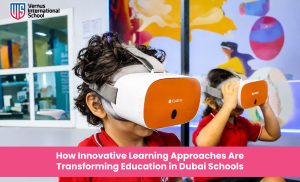
Virtual reality classrooms in Dubai schools tend to be the single thing that grabs the most attention from parents touring schools for the first time, and they’re also the feature that deserves the most careful scrutiny to figure out whether it’s genuinely adding something to the learning experience or simply adding something photogenic to the school’s marketing materials.
VR as a technology opens up experiences that a conventional classroom simply cannot manage on its own, walking through the streets of a historical city that no longer exists, observing a scientific process unfold at a scale that’s impossible to recreate with physical materials in a normal classroom, exploring a geography or culture the school could never realistically take a child to visit in person.
The question worth asking on any school tour is whether a particular school is using VR to build experiences along these lines, or whether it’s mostly using the technology to deliver content that a well-made video, or even a good book, could have handled just as effectively without the headset. The technology earns its place in a curriculum when it’s creating something genuinely immersive that nothing else realistically could. It earns considerably less credit when its main function is making fairly ordinary content delivery feel a bit more high-tech and impressive to watch from the sidelines.
What STEAM Builds That Separate Subjects Often Don’t
STEAM schools in Dubai are deliberately pulling science, technology, engineering, arts and mathematics into a working relationship with each other that the more traditional subject-by-subject curriculum tends to keep firmly apart. A child learning mathematics and science as two completely separate, unconnected subjects, taught in different periods by different teachers with no obvious thread between them, isn’t really learning how these two disciplines actually function together out in the real world, because out there, mathematics is essentially the tool that science uses to make itself precise and testable. A child who is applying mathematics directly to an actual science problem, rather than learning the maths in one classroom and the science in another, tends to end up understanding both subjects more deeply than a child learning them in isolation from each other.
The arts component within STEAM is the part that generates the most debate among parents and educators, and it’s arguably also the most important piece of the whole framework. Design thinking, the iterative process of generating a possible solution, testing it, getting feedback, and refining it again, is genuinely how engineers, scientists and technologists work when they’re doing their most serious problem-solving, and at its core that process is fundamentally an arts and design skill that’s simply being pointed at a technical or scientific problem instead of a purely creative one.
Vernus International School’s Innovation Lab and VR programme sit inside a broader curriculum built on the California State Standards, with project-based learning running as a core teaching method from the very earliest year groups onward rather than being introduced only once children reach a certain age. The STEM approach runs alongside the school’s specialist enrichment areas, technology and innovation, farming and gardening, music and arts, sports and wellness, all of which sit inside the regular weekly programme rather than appearing as occasional special events. visdubai has the full breakdown of how the curriculum is structured and what these innovative learning elements actually look like on an ordinary school day.
Frequently Asked Questions (FAQs)
1. What is project based learning and how does it differ from regular classroom teaching?
Ans. It uses a project as the actual setting where learning happens, rather than as an exercise added after content has already been taught conventionally. Children build skills and knowledge by actually using them to make or solve something, rather than simply receiving information to repeat later.
2. What does virtual reality add to learning in Dubai classrooms?
Ans. Done well, it creates immersive experiences a normal classroom can’t manage, visiting historical places, experiencing scientific processes at scale, exploring locations the school could never physically take a child to. Whether it’s genuinely worth having comes down to whether it’s being used for that purpose or simply to deliver regular content in a flashier format.
3. What’s the difference between STEM and STEAM?
Ans. STEAM adds arts onto science, technology, engineering and mathematics. The arts component brings in design thinking, the iterative process of refining a solution through feedback, which is genuinely how engineers and scientists solve difficult problems in real practice.
4. What innovative learning features does Vernus International School have?
Ans. An Innovation Lab, a VR programme, a STEM approach and project based learning running from the earliest year groups, alongside specialist enrichment in technology, the arts and several other areas built directly into the regular curriculum.